
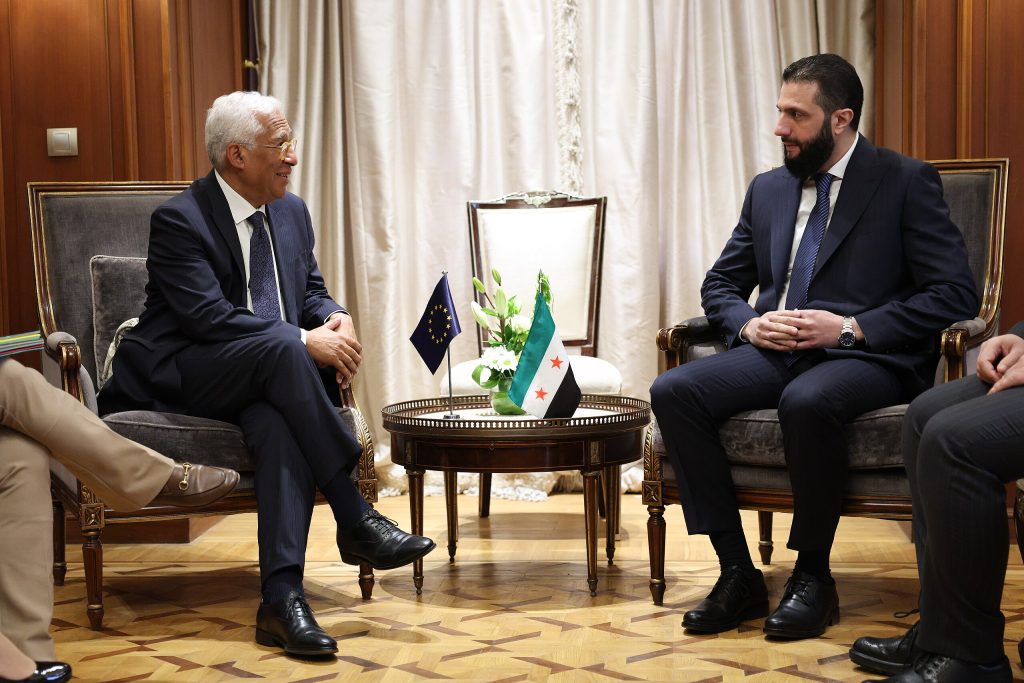
Syria’s First Parliament After Assad: Empty Seats and Empty Promises?
Syria’s first elections after the fall of Bashar al-Assad were meant to mark a new beginning. Instead, they produced a parliament without diversity or dissent. What emerges is not a body for the people, but a hollow chamber echoing the habits of the past. Can Syria rebuild its political life on such fragile ground?
In early October, Syria held its first elections since the fall of the Assad regime. However, there were no votes being cast in Sweida, Raqqa, and Hassakeh — provinces that together house more than a third of the country’s population. Ballot boxes were never opened, candidate lists were never published, and not a single representative was elected there. It was not an electoral failure that caused this event (or rather non-event). Instead, the regions were excluded from the outset. The official justification offered by the new Syrian government amounted to two words: “security challenges.” The truth was less opaque: The regions simply did not recognize Damascus’s authority — and the central government lacked the capacity and the will to do anything about it.
In that sense, the October 5 elections did not amount to a popular vote, but a closed, hierarchical procedure. In June, Interim President Ahmed al-Sharaa issued “Presidential Decree No. 66,” appointing a High Committee headed by Muhammad Taha al-Ahmad to form “voter bodies” to which ordinary citizens have no access. There were no polling stations in neighborhoods, no online registration, no public campaign activities. The people, simply put, were absent. Power, however, in all of its forms, was ever-present.
An election that made history — for all the wrong reasons
Of the 140 seats put up for election, only 122 were filled. The remaining seats in the three marginalized provinces remain vacant until today, pending elections whose dates have not yet been announced. The other 70 of the parliament’s 210 total seats were reserved for direct presidential appointment — granting the interim president an unprecedented structural influence over the composition of the legislative body.
Regarding female representation, the figures reveal a startling reversal: only six women were elected — just 4 percent of the actual seats — distributed as follows: two members are from Tartous, and one each from Aleppo, Homs, Hama, and Latakia. This is the lowest level of female parliamentary representation in decades — much lower even than under the Assad regime.
For comparison, female representation was highest in 2020, when 33 women filled more than 13 percent of the seats in parliament. This was thanks to reserved quotas in certain districts. As a result, even under the authoritarian regime — which used women as facades — the representation rate was higher than it is today (though most female candidates, of course, were loyalists of the National Progressive Front and Assad’s Ba’athist coalition). In today’s parliament even those basic mechanisms are lacking. There are no quotas, no balanced nominations, and no appointments to restore a gender equilibrium.
However, the lack of representation extends much further than gender imbalances and geographical exclusion — it relates to the social composition of the parliament, too. In the new parliament, professional elites have replaced workers and farmers, who for decades formed the backbone of the body. Now, engineers and doctors each make up 17 percent of the chamber, economists account for 10 percent, and religious figures represent 7 percent — numbers incongruent with the aspirations of a transitional phase meant to build a civil state atop the ruins of the old regime.
A parliament of yes-men?
To anyone who followed Syrian politics and al-Sharaa’s rise, the early warning signs for this trend were clear — not only with respect to social classes or ethnic groups, but also regarding the political landscape itself. Before the elections — and following the announcement of the “Conference of Victory” after Assad’s fall — the interim president issued a decree dissolving all political parties in Syria, including those that had existed since the early days of the Syrian Republic: the Ba’ath Arab Socialist Party, the Arab Socialist Union, and even historic leftist and nationalist parties. This decision — made without public consultation or constitutional reference — destroyed Syria’s political infrastructure and paralyzed the societal organizations that once served as bridges between citizens and the state.
These conditions, combined with Decree No. 66, exclude candidates through opaque, quasi-secret criteria: anyone who has run for office after 2011 (even opponents of the Assad regime), military personnel, senior state officials, “supporters of the former regime,” and “separatist advocates” cannot run for office. At the same time, however, no detailed list of accepted and rejected candidates was ever published, nor were the reasons for rejection disclosed.
The result of these developments is not an opposition or a pro-regime parliament, but a homogeneous body ideologically aligned with the transitional authority — one that does not pose fundamental questions but merely ratifies decisions made by a leadership lacking genuine popular legitimacy. The major components of Syrian society — Kurds, Druze, Alawites, Christians, and Sunnis of various sects — were not granted the right to choose their own representatives. Instead, they were presented with top-down choices that were assigned representative meaning by the government but wield no real authority in the communities they are meant to serve.
Unless minorities have rights, democracy remains a mirage
The solution for these self-made problems does not lie in appointing loyalists from certain communities. It lies in granting them clear political rights: the right to form locally elected bodies, the right to stand for election without security vetting, and the right to participate in drafting legislation that affects their identity and rights. Without these guarantees, representation remains symbolic, and democracy a mirage.
Unless the transitional authority reverses course, Syria’s political and social fabric will remain as fragile and weak as it has been for over two decades. Although the BTI 2026 is set to record the largest improvement in “political transformation” among all 137 countries tracked for Syria — and despite a leap in “regional cooperation” — these gains remain superficial unless the political system includes the people it is supposed to represent. It is no surprise then, that indicators such as “policy learning”, “reconciliation”, and “consensus on goals” have flatlined for years. In a post-Assad Syria where an institutional void is being hastily filled with structures lacking genuine popular legitimacy, none of that is bound to change. The country suffers under the deliberate reproduction of power from above.
The way forward does therefore not lie in going down the same path as the previous regime with different rhetoric. It demands that al-Sharaa publicly acknowledges that Syria is a multi-communal state — and translates that acknowledgment into constitutional rights guaranteeing each community effective, not symbolic, representation. To that end, the 70 presidentially appointed seats must be used not only to enhance female representation — which cannot be sacrificed at such a foundational moment — but to restore a social balance long lost. Most crucially: Decree No. 66 must be revoked. Direct, wide-scale elections under neutral international supervision must be instituted, allowing every Syrian — whether in Damascus, Qamishli, Sweida, or Idlib — to choose their own representative.
Without these steps, the first parliament after Assad will remain an empty shell: elections without legal framework, a parliament without a people, transformation without democracy.
*DISCLAIMER: The final reports underscoring the improvements in political transformation referring to the BTI 2026 mentioned above will be published in early 2026.
First published on zenith.me
Good article and useful information