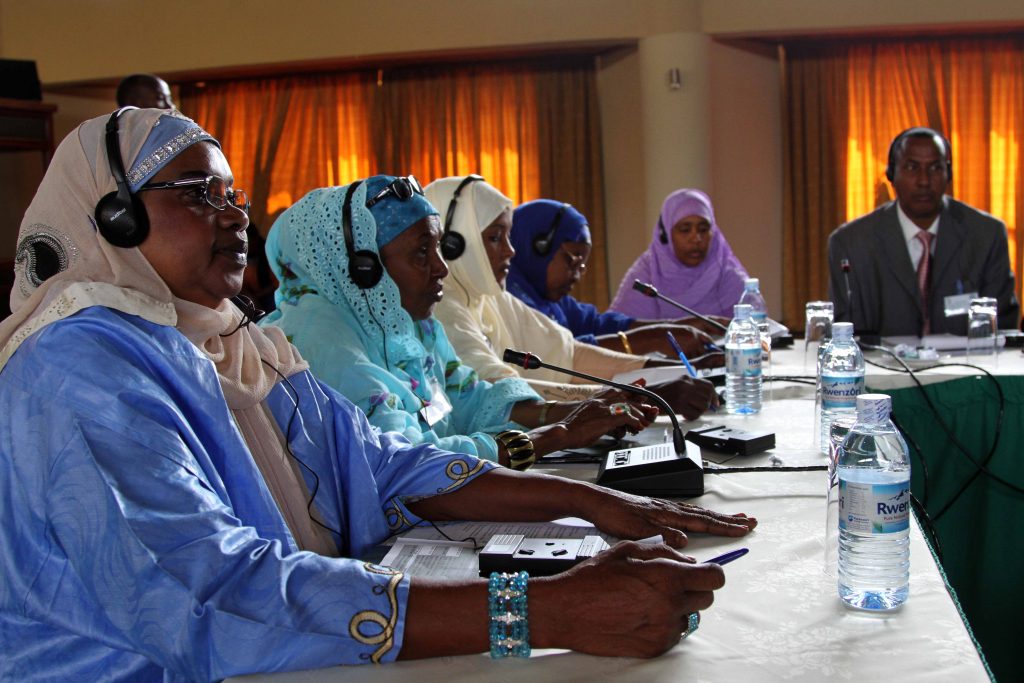
From the margins to the center? In Uganda, resolutions meet reality
Women play a central role in peace, stability, and the economy, yet they continue to be excluded from political decision-making processes. However, a few surprising examples from Africa show that inclusivity can be reality: in authoritarian Uganda, local initiatives are breaking through cultural and constitutional norms. Meanwhile, government strategies still rarely lead to change.
A quarter of a century ago—on October 31, 2000—a political breakthrough seemed to have been achieved: with the adoption of UN Resolution 1325 the United Nations Security Council recognized that there can be no sustainable peace without the participation and leadership of women. The document emphasized “the important role of women in conflict prevention” and the importance of their “involvement in all peace efforts […] and related decision-making processes”” For the international community, the resolution was not only intended as a well-meaning declaration of intent, but as a binding mandate: it committed all UN member states to systematically involve women and their experiences in peace efforts, prevent gender-based violence, and consistently prosecute perpetrators.
Today, roughly 25 years later, this noble project has still not been implemented. On the contrary, as the latest report on “Women, Peace and Security” by the UN Secretariat shows, the reality could hardly be more sobering. 676 million women—almost 17 percent of the world’s female population—now live in close proximity to conflicts. In addition, the number of civilian casualties among women and children has quadrupled in the past two years, and sexual violence in conflicts has increased by 87 percent during the same period. In an increasingly militarized world, the grand promise of women’s inclusion seems to have degenerated into empty rhetoric.
Despite indisputable evidence that the involvement of women makes peace processes more stable, they remain largely excluded. Although women make up almost 30 percent of parliamentarians worldwide, this presence rarely translates into real decision-making power. Only 27 countries have women at the helm of government—such as Maia Sandu in Moldova, Samia Suluhu Hassan in Tanzania, and Claudia Sheinbaum in Mexico. In contrast, however, there are 103 nations that have never had a female head of state. The often-rigid distribution of ministries further exacerbates this imbalance: women are primarily employed in social and humanitarian offices, while strategically important policy areas such as finance and defense remain male-dominated, with over 77 percent of positions held by men. Minor statistical advances thus obscure the fact that patriarchal structures continue to solidify without far-reaching reforms.
Although numerous states have now developed national action plans to implement Resolution 1325, the practical impact on the reality of women’s lives remains limited. In 2024, women were not represented as negotiators in nine out of ten peace processes, and worldwide they accounted for only seven percent of negotiating delegations and 14 percent of mediators.
From resolution to reality
However, alongside a whole series of discouraging figures and statistics, there are also some rays of hope: countries that have implemented their international commitments and where the measures are actually having an impact.
Uganda is often cited as a positive example in this context. In fact, as early as 2008, the country was one of the first African states to incorporate elements of the Women, Peace and Security Agenda into state structures and create formal spaces for women’s participation. The comparatively high proportion of women in parliament, at 34.1 percent—higher than in Germany—contributes to this image. Behind this facade, however, political power remains highly concentrated. This is mainly because, although women hold political office, they ultimately operate within a strictly presidential system that has been dominated by Yoweri Museveni for almost four decades. Opposition, civil society, and independent control mechanisms remain systematically limited.
Against this backdrop, programs to promote women also fulfill a foreign policy function: they signal progress, secure international recognition, and bring funding into the country. This narrative is particularly appealing to Western donors. However, it does little to change the structural balance of power. As the Bertelsmann Transformation Index (BTI) shows, democratic institutions in Uganda remain limited in their ability to act, while real political power continues to be reserved for a small political elite.
Nevertheless, the example of Uganda shows that progress can be achieved even where the aftermath of conflict and existing power structures make sustainable change difficult. When governments recognize that involving the female population can help to fully exploit a population’s potential, then much becomes possible. Uganda has maintained peace and relative stability for over three decades, made economic progress, and aims to become a middle-income country by 2040.
This ambivalence between social and political obstacles and tangible progress for women is omnipresent in Uganda. In rural areas, women who have fewer children than the national average often receive less social respect—and around half of all women between the ages of 15 and 49 have experienced physical violence. In addition, women in agriculture are responsible for most of the physical work, while men continue to control distribution. These conditions are changing only slowly. Property rights and inheritance laws also remain heavily biased in favor of men. Although the state has been trying to strengthen the position of women in these areas for years, the constitution and cultural norms have so far prevented any significant breakthroughs. If a woman uses the shared land or house after her husband’s death, she is criticized and sanctioned for doing so. Meanwhile, polygamy—as the Ugandan Constitutional Court confirmed again this year—continues to be legally protected and culturally entrenched. According to the ruling, religious freedom in the country takes precedence over criticism of discrimination against women.
New opportunities or strategic calculations?
At the same time, however, Uganda also has a distinctive and increasingly egalitarian corporate culture. It is no coincidence that the country is now one of seven countries worldwide that have achieved gender parity in the business world. Even though it has fallen slightly since 2012, the employment rate for women remains high compared to other countries in sub-Saharan Africa—despite the fact that the COVID-19 pandemic has put severe strain on labor markets and hit women harder than men.
The positive developments of a more women-oriented policy are clearly visible in Uganda: genital mutilation has declined significantly, and women can report sexual violence to the police. Special forms and trained officers have been in place for some time to facilitate this. In addition, many communities now have female peace mediators who are socially respected and also respected by men. In the economy, projects such as “African Girls Can Code” give young women the opportunity to acquire programming skills and enter the IT sector — an area in which women are still severely underrepresented. Very similar training programs have been created in other “male domains,” such as automotive engineering, even though the actual job market opportunities for women are still limited.
The Ugandan government offers aspiring female entrepreneurs targeted access to financing instruments through the national gender ministry. The Uganda Women Entrepreneurship Program provides interest-free loans to local women’s groups, while the World Bank-funded GROW project aims to promote the scaling up of businesses through reduced interest rates. In addition, the state-owned Uganda Development Bank (UDB) provides capital for larger investments through its Women Prosper Loans.
However, these initiatives also suggest a strategic motivation on the part of the Museveni government: the targeted promotion of women could serve as an instrument of “gender diplomacy” to generate international prestige and secure the inflow of global funding. In a system where parliamentary control is effectively weakened, these programs create the impression of a progressive model country.
No change from above without initiatives from below
At the same time, many measures in Uganda go beyond mere symbolic politics and have created lasting institutional structures that provide concrete support for women and strengthen their participation in a visible and long-term manner. A central foundation of these developments was the early and systematic anchoring of gender strategies at the national level—even if the government’s motivation was based less on feminist convictions than on power-political calculations. Unlike many other UN member states, Uganda developed national action plans for the implementation of Resolution 1325 at an early stage and established programs to promote women in politics, business, and education. The fact that these initiatives were consistently implemented within state structures gave them a binding force that even male officials hardly questioned openly.
However, it is civil society rather than the state that is crucial to the actual success of these measures. Although the government has created formal structures, these are most effective where they are brought to life by civil society actors. In Uganda, almost all relevant programs are closely linked to international organizations, NGOs, or external donors—an indication of the country’s heavy dependence on foreign funding. At the same time, initiatives founded by Ugandan women are usually the ones that initiate sustainable change. They develop ideas, implement projects, and anchor them in their communities. Consequentially, progress is most visible where women are not only the target of government programs, but also act as political and social actors themselves.
An impressive example of this is the project ”Bwera United Women with Disabilities Association,” or BUDWA for short, which enables women with disabilities to participate fully in society. Founded by a woman suffering from polio, the organization now gives more than 20 women the opportunity to earn their own income despite their disabilities. At the beginning of the 2000s, such a development would have been unthinkable in Uganda. At that time, people with disabilities were largely marginalized. Projects such as BUDWA show that targeted civil society engagement can break down social barriers and effectively promote inclusion.
The key to success seems to lie in the fact that political measures usually start at the community level, local authorities, police, and the population are involved in training programs, and the measures taken take into account the concerns and customs of the local people. This makes it easier to establish new ways of thinking step by step.
Dependencies, roadblocks and real change
Nevertheless, Uganda’s gender equality policy remains a balancing act: on the one hand, government credit programs and the support of international organizations are having an impact, awareness of empowerment is growing, and where NGOs are active, women are changing their economic reality “from the bottom up.” But this progress is hitting a hard glass ceiling. Despite modern laws, there is a huge gap between aspiration and social reality.
This is particularly evident in land ownership: although male privileges have been abolished by law, according to BTI data, control over land remains almost exclusively in the hands of men. Without these property titles, women lack the collateral for loans and the means to build up their own assets. As a result, good initiatives often come up against unequal educational opportunities and traditional claims to power. True change is taking place, but it remains difficult as long as political programs primarily seek to secure international prestige rather than consistently breaking down deep-rooted patriarchal barriers in education and inheritance law.
Nevertheless, anyone who talks to young women in the country today will meet people who dare to dream big.
Also published by Fair Observer.