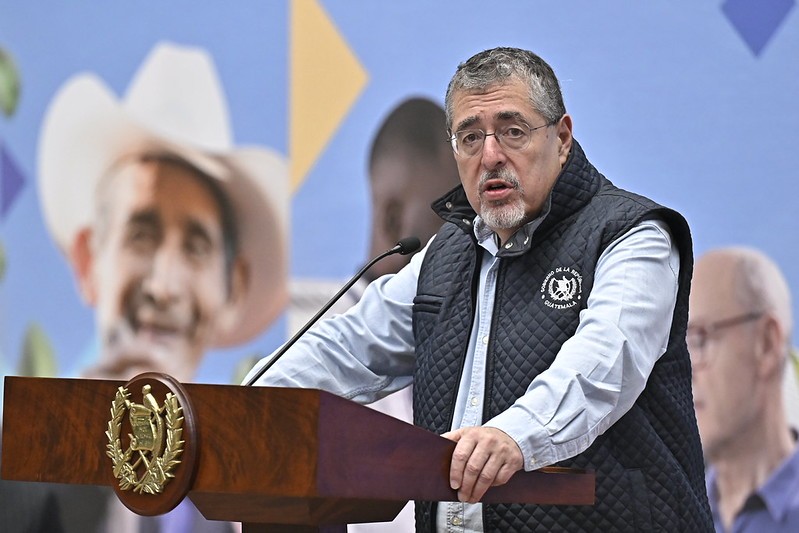
A Stalled Transformation: Guatemala’s Struggle for Democratic Reform
Bernardo Arévalo’s unexpected victory in Guatemala’s 2023 run-off election raised hopes of a decisive break with the country’s entrenched systems of corruption and elite capture. Two years into his presidential term, however, the momentum of reform has largely stalled.
Bernardo Arévalo’s swearing-in on January 15, 2024, represented more than an electoral win. It marked a rare victory against entrenched economic and military elites. Civil society mobilization played a decisive role, successfully thwarting judicial attempts to prevent the president-elect from taking office. For many Guatemalans, particularly after years of authoritarian drift, Arévalo’s presidency embodied a long-awaited opportunity to restore democratic governance and the rule of law.
However, this initial optimism quickly faded as political realities set in. In a system where elite actors have effectively taken control of the judiciary to protect the interests of an informal alliance of politicians, businesspeople, and bureaucrats—the so-called “pacto de corruptos”—the prospects for meaningful reform were always limited. Rather than referring to a single political bloc, the term describes a historically rooted, cross-sectoral system of elite clientelism, defined by its durability across successive governments and its core function: the reproduction of existing economic and political power structures while systematically evading accountability.
This has also been documented by the Bertelsmann Transformation Index (BTI), which points to a steady decline in judicial independence, with a score of 2 out of 10 possible points. Similarly, the index finds that the separation of powers in the country is increasingly weak, with a score of 4, indicating that these institutional shortcomings predate the current government and continue to constrain it.
Institutional Resistance and Elite Pushback
Despite the government’s commitment to exposing corruption within state institutions, the judicial system continues to be used as a political weapon. Prosecutors and judges are deployed to grant impunity to elites and restrict elected officials, including the president and his party.
Arévalo’s centre-left Movimiento Semilla has been a primary target of these efforts. Politically motivated actions by the Public Prosecutor’s Office, headed by Attorney General Consuelo Porras, have forced its elected representatives to operate as independents in Congress. This has prevented them from being recognized as a parliamentary bloc, from chairing committees, and from holding certain leadership positions, significantly weakening the government’s legislative capacity and further entrenching institutional paralysis.
Political Deadlock and Governance Challenges
These pressures have been exacerbated by long-standing fragmentation within Congress and, more recently, within the ruling movement itself. In May 2025, a group of former Semilla members formed a splinter group known as “Raices.” While supporters described the move as a strategic repositioning ahead of the 2027 elections, critics see it as evidence of weak internal coordination and limited leadership capacity within the ruling camp.
The combined effect of judicial obstruction, legislative fragmentation, and internal divisions has produced sustained political deadlock. Key reform initiatives central to Arévalo’s agenda—particularly anti-corruption and institutional reform efforts—have either stalled in Congress or failed to advance beyond the proposal stage.
High levels of gang-related violence further complicate this picture, reinforcing perceptions of a state unable to deliver basic protection. In such a context, governance failures risk being interpreted not only as political setbacks, but as a broader inability to guarantee order and stability.
Public Expectations and Signs of Eroding Support
Public expectations following the 2023 election were exceptionally high—and Arévalo’s victory was largely driven by the mobilization of indigenous communities and other social groups who viewed the election as a vote for democracy rather than a personal endorsement of the president. Yet many of these actors have since expressed disappointment, particularly over the government’s inability to remove the Attorney General—a central campaign promise that ultimately lacked sufficient congressional support.
The widening gap between expectations of rapid change and the reality of an executive constrained by hostile institutions has fueled frustration and declining confidence in democratic reform. This disillusionment carries broader implications for democratic legitimacy in Guatemala, where many citizens have already endured years of unfulfilled promises.
Near-Term Prospects and Institutional Turning Points
Looking ahead, the prospects for reform under Arévalo remain closely tied to a series of high-stakes institutional appointments currently underway. These processes—covering the Constitutional Court, the Supreme Electoral Tribunal (TSE), the Public Prosecutor’s Office, and other key oversight institutions—are widely seen as decisive for the future of democratic governance in Guatemala.
Recent developments, however, point to a constrained outlook. The newly appointed Constitutional Court for the 2026–2031 period appears to reflect significant continuity with existing power structures, raising doubts about its willingness to challenge entrenched interests. Similarly, the selection of TSE magistrates by an opposition-dominated Congress has sparked concerns about political capture, with potential implications for the credibility of the 2027 elections.
The process of appointing a new Attorney General remains uncertain and highly controversial. Given the critical role this position plays in prosecuting corruption and safeguarding judicial independence, the outcome of this selection will be decisive for any meaningful reform initiative.
In the short term, Arévalo’s room for maneuver remains limited. While incremental progress may be possible through public pressure or international support, the overall trajectory suggests continued institutional friction.
Lessons from Guatemala’s Impasse
Guatemala’s current stalemate underscores that reform failure is not merely a matter of leadership or political will. It is rooted in deep structural constraints, institutional capture, and entrenched elite resistance. For Arévalo, the challenge is not only to govern, but to do so within a system designed to block change.
The Guatemalan case offers democratic reformers across the region a sobering lesson: electoral victories alone are insufficient when institutions remain hostile to transformation. Without addressing these structural barriers, democratic reform risks giving way to renewed frustration and more radical alternatives.
First published by Global South World