New Pathways from West Africa to Vocational Training and Employment
As part of the Global Skills Partnership project, the Deutsche Gesellschaft für Internationale Zusammenarbeit (GIZ) is cooperating with Bauverbände NRW e. V. The aim is to identify, pilot, and establish fair, legal, and professionally sustainable migration pathways from Ghana and Senegal into the German construction sector that create a “triple win” for all stakeholders involved.
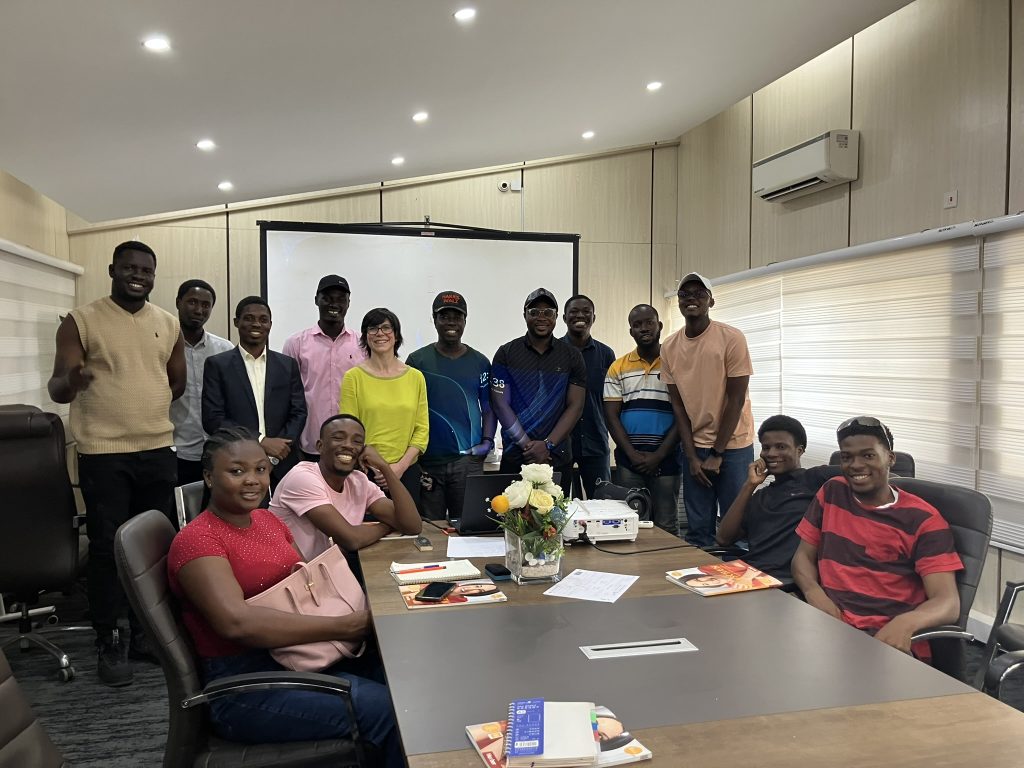
“Punctuality is typically German,” says one student during a German language class at the Goethe-Institut in Accra. The seasons and beer are also mentioned as typical images associated with Germany. For the participants in the project “Global Skills Partnership between Senegal/Ghana and Germany,” such impressions are more than anecdotes: they are part of preparing for a country where they may begin vocational training in the construction industry as early as the summer of 2026. The project combines language learning, technical training, intercultural orientation, and migration counselling. In this way, skilled migration is understood not merely as recruitment, but as an educational and structural task.
Demand for Skilled Workers and Partnership
The background is equally structural in nature. Germany is facing growing shortages of skilled workers across many sectors, including construction. Demographic change is intensifying this development: many employees are reaching retirement age, while fewer young people are entering vocational training. The Bertelsmann Stiftung therefore views transnational vocational training partnerships as an approach that links migration, education, and labor market policy. Countries of origin, destination countries, and migrants themselves are all intended to benefit equally. This “triple win” perspective differs from short-term recruitment strategies and seeks to reduce risks such as brain drain.
This perspective is particularly significant in the construction sector. Construction companies require not only additional workers but also reliably trained skilled professionals who can work safely on construction sites and as part of teams. Vocational education encompasses occupational health and safety, knowledge of materials, the use of machinery and tools, technical communication, and quality assurance. Professional standards, language proficiency, and workplace integration therefore need to be considered together. This blog post adopts the triple win perspective to examine the benefits that this project approach offers for countries of origin, migrants, and destination countries alike.
Bridging the Gap to Construction Practice
Within the project, Bauverbände NRW e. V. primarily serves as a practical partner with technical expertise. The association contributes its experience with the so-called “pool approach,” helps classify the requirements of Germany’s dual vocational training system in construction and supports contacts with interested companies. Its role is therefore less about project management than about translating between project structures and operational practice: What conditions do companies need to host international apprentices? What support is required before, during, and after their arrival in Germany?
Findings of the Exploratory Study
An exploratory study conducted by the Bertelsmann Stiftung on North Rhine-Westphalia and Ghana shows that there is, in principle, openness within the construction sector towards a structured vocational training partnership. In the qualitative study, all 13 companies interviewed reported a need for skilled workers or apprentices; the main reasons were an ageing workforce and too few suitable applicants. At the same time, it became clear that many companies would prefer to train young people themselves rather than recruit only workers who are already fully qualified. The study therefore highlights two key findings: the demand exists, and such a partnership can only succeed if preparation, selection, language training, and workplace support are organized in a reliable manner.
Ghana as a Partner Country
The selection of Ghana as a partner country builds on the Bertelsmann Stiftung’s earlier work. In the country profile “Ghana – A Vibrant Civil Society,” prepared for the Reinhard Mohn Prize 2013, Ghana was described as a country that has developed stable institutions, an active civil society, and foundations for sustainable development since the democratic elections of 1992. At the same time, the profile also pointed to existing challenges: weak infrastructure, regional poverty, corruption, illegal gold mining, and limited implementation capacity. This dual perspective is important for the Global Skills Partnership project. Ghana is not idealized but understood as a partner with strengths, challenges, and its own development objectives. Consequently, the vocational training partnership must be firmly rooted locally and create tangible benefits for the Ghanaian labor market as well.
Together with Liberia, Sierra Leone, The Gambia, and Senegal, Ghana is one of only five countries in the West and Central African region that the BTI 2026 classifies as a democracy. The peaceful transfer of political power following the 2024 elections underscores Ghana’s exceptional political stability and democratic resilience in a region that is becoming increasingly repressive and autocratic.
At the same time, Ghana’s long-term development continues to be shaped by a constrained fiscal environment and numerous development challenges. One of the government’s key priorities therefore remains improving both access to education and the quality of education. Although the country’s secondary and tertiary education systems have steadily improved, vocational education and training is still characterized by a high degree of informality and a shortage of qualified instructors.
In recent years, the government and international donors have placed greater emphasis on practical vocational training and have implemented reforms in the Technical and Vocational Education and Training (TVET) system, which offers a range of certificate programs lasting between one and four years. Following the abolition of tuition fees under the “Free TVET for All“ initiative, enrolment in TVET programs had risen significantly to around 150,000 students by 2023.
Two Building Blocks: Vocational Training and Skills Development
The first pathway is migration for vocational training, with preparation taking place in the country of origin. Young people from Ghana and Senegal complete intensive language courses with the goal of reaching German language level B1. After successfully passing the language examination, they are matched with interested companies. In Germany, they begin a regular dual vocational training program in the construction sector. Upon successfully completing their final examinations, they are qualified to work as skilled construction workers. This pathway is demanding, as language training, visa procedures, apprenticeship placement, housing, and workplace support all need to be carefully coordinated.
The second building block consists of technical training programs in Ghana and Senegal. These either prepare participants for a later start of vocational training in Germany or strengthen the qualifications of individuals who intend to work in their home countries. Under the hybrid model, which has already been established in Senegal and is currently being prepared in Ghana, training content is aligned with international standards and certified by the German Chamber of Commerce Abroad. As a result, the program not only creates migration opportunities but also provides qualifications that are valuable for local labor markets.
Capacity Building
One key difference from traditional skilled worker recruitment lies in the project’s focus on building structures within the partner countries. In Ghana and Senegal, curricula are being modernized, vocational instructors are receiving further training, and training centers are being equipped with modern technical facilities. This approach not only prepares participants for potential migration but also strengthens vocational education systems locally. From a development policy perspective, this is essential: a partnership can only be considered balanced if it does not merely draw capacity away from partner countries but instead creates qualifications, raises professional standards, and expands employment opportunities locally.
At the same time, implementation remains challenging. Language courses, examinations, and visa procedures constitute significant entry barriers. Moreover, the pathway into a profession often already fails because of limited access to education in the country of origin. In Senegal, for example, there are considerable differences between boys and girls in the average number of years of formal education. This is often linked to the early marriage of young women or their early entry into the informal economy, both of which can lead to premature school dropout.
On the German side, another challenge is matching candidates with companies. Small and medium-sized enterprises tend to be cautious during times of economic uncertainty, as international vocational training requires additional organizational effort. For many companies, West Africa also remains a relatively unfamiliar region. Consequently, guidance and examples of good practice are essential. The shortage of skilled workers in the construction sector is not a short-term cyclical issue but a long-term structural challenge.
Experience to date indicates strong interest at many levels: among government ministries, vocational training institutions, the German Chambers of Commerce Abroad, the European Union Delegation, project partners, and individual companies. Wherever people from Ghana are already employed by German construction companies, employers report a very high level of satisfaction. Whether this initiative develops into a sustainable model will depend on the quality of its implementation and on its potential for long-term institutionalization. Transparent selection procedures, realistic expectations, continuous support, and a fair distribution of costs and benefits are all crucial. Transnational vocational training partnerships can only make a meaningful contribution if they are understood as long-term cooperation in education and labor market development.
Outlook
For the construction industry in North Rhine-Westphalia, this presents a valuable opportunity. It can open additional pathways into vocational training while bringing international experience into companies. For participants from Ghana and Senegal, the project creates professional opportunities both in Germany and in their home countries. The key measure of success is therefore not simply the number of apprentices placed. Rather, the decisive question is whether sustainable structures are created that extend beyond individual cohorts and enable fair and transparent labor migration in the construction sector.
In this respect, the project genuinely contributes to a “triple win” by creating opportunities and benefits for all parties involved: the countries of origin, the destination country, and the participating individuals. At the same time, the process remains highly demanding and can only succeed if sufficient time is allowed, partnerships are built on trust, and the necessary institutional framework conditions are in place. The existing differences between the education and vocational training systems mean that the pathways from the two West African countries to Germany are still long. However, they can be developed step by step. Projects such as this therefore represent an important step towards establishing broader and fairer pathways for labor migration and labor market integration.