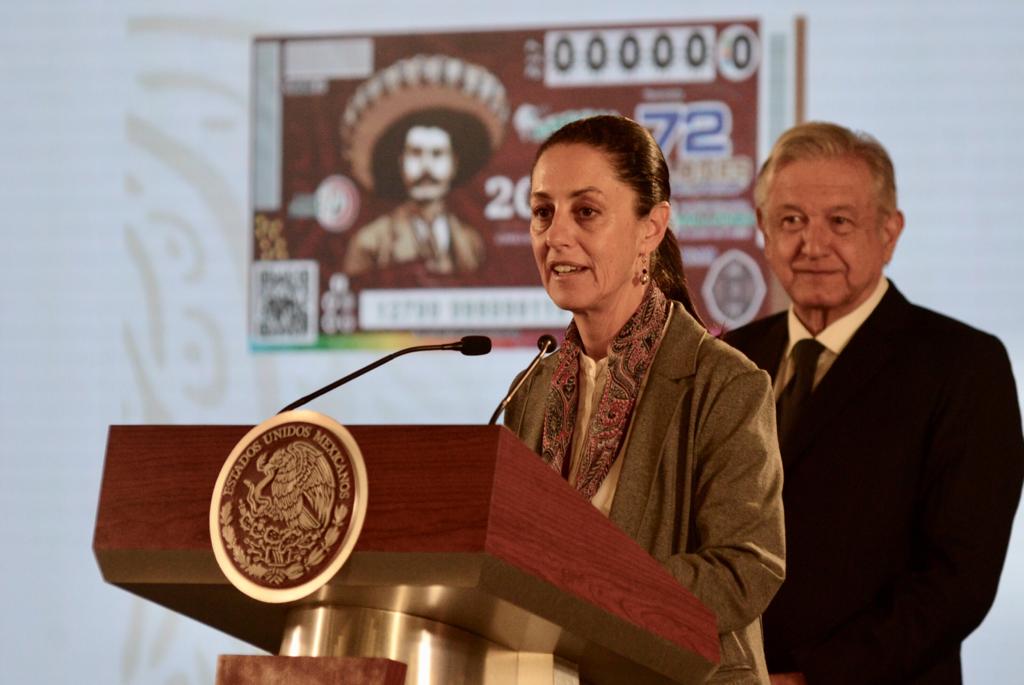
From Feminist Symbolism to Centralized Power: Mexico under Claudia Sheinbaum
In October 2024, Mexico’s first female president took office amid high hopes and historic symbolism. But early governing choices suggest continuity rather than rupture. Institutional power is consolidating as democratic guardrails weaken.
When President Claudia Sheinbaum won Mexico’s June 2024 election with nearly 60 percent of the vote, a cautious sense of optimism spread both domestically and abroad. “Presidenta, with an A,” she proclaimed repeatedly at rallies. As the country’s first woman president in a deeply patriarchal society, the moment carried undeniable symbolic weight—especially in a country long marked by gender-based violence and deep economic and political inequality.
Yet symbolism has not translated into gender equality as a central pillar of Sheinbaum’s governing agenda. Instead, the early phase of her presidency has been defined by the implementation of sweeping judicial and electoral reforms originally proposed by her predecessor, Andrés Manuel López Obrador (also known as AMLO), the founder of her party, Morena (National Regeneration Movement). These initiatives have dominated legislative activity, signaling a strategic emphasis on institutional restructuring rather than social or redistributive policies. Under Sheinbaum, Morena has recalibrated Mexico’s democratic architecture, systematically redesigning—or dismantling—institutions originally created to limit executive power.
Power Without Friction
This transformation is underpinned by an unprecedented concentration of political authority. In the 2024 elections, Morena dramatically expanded itscontrol at the state level: the number of Morena governors rose from four to twenty-four of Mexico’s thirty-two states, collectively representing more than 72 percent of the population, often through electoral coalitions. At the federal level, Sheinbaum commands the strongest majority in the lower chamber since 1982, when the Institutional Revolutionary Party (PRI) governed as a hegemonic force. As a result, opposition parties have been severely weakened.
This concentration of power is reshaping the mechanics of governance. Institutional friction has diminished, as seen in the swift passage of constitutional reforms to expand the military’s role in public security and the approval of the judicial reform that restructures the Supreme Court and introduces the popular election of judges—both advanced with limited cross-party negotiation. In each case, Morena’s legislative dominance reduced the need for coalition-building, narrowing the space for pluralistic deliberation and weakening traditional checks and balances. Policy decisions are now largely settled within Morena’s internal structures rather than through open democratic contestation.
Mexico’s current political moment cannot be understood as the product of a single election cycle or reform package. The country’s long transition to democracy—unfolding over decades and culminating in the peaceful alternation of power in 2000—was widely described as the end of the PRI’s “perfect dictatorship”, a term popularized by Mario Vargas Llosa and later echoed by Mexican writers like Juan Villoro in assessing Mexico’s uneasy democratic consolidation. That transition sought to dismantle the authoritarian structures consolidated during the PRI’s late-twentieth-century dominance. Today, however, Mexico’s power configuration increasingly resembles earlier periods, such as the presidency of Gustavo Díaz Ordaz (1965-1970), when authority operated through formal constitutional mechanisms concentrated within a centralized presidential authority, strict control over political opposition and the press, and the violent repression of dissent. The presence of prominent Morena figures such as Marcelo Ebrard, Manuel Bartlett, and Mario Delgado—all of whom built their careers within the PRI before migrating to Morena—underscores continuity rather than rupture.
The democratizing reforms of the late twentieth century rested on fragile pillars that are now under strain. Political pluralism, once gradually institutionalized through competitive elections and proportional representation, has been eroded by Morena’s overwhelming congressional dominance.
Redesigning Institutional Independence
The judiciary—once conceived as an independent constitutional counterweight and a guarantor of fundamental rights—was overhauled in the 2025 judicial elections. Approved by an estimated turnout of just 13 percent amid widespread voter confusion, the reform fundamentally alters the courts’ role as an independent arbiter. Initiated under AMLO and supported by Sheinbaum, the overhaul politicizes the judiciary and weakens the rule of law. Rather than constraining executive authority through technical and professional oversight, the judiciary now aligns more closely with the ruling party and faces heightened exposure to infiltration by organized crime through politicized judicial appointments.
This reform is not an attempt to expand her personal executive apparatus, but it does represent a structural consolidation of Morena’s long-term dominance. By reshaping the judiciary’s composition and weakening its autonomy, the governing party reduces institutional counterweights that could constrain future administrations.
Electoral institutions, long regarded as cornerstones of Mexico’s democratic transition after the disputed 1988 elections, are also poised for transformation. Sheinbaum’s proposed reform of the National Electoral Institute (INE) would significantly reshape Mexico’s electoral system by introducing the popular election of electoral authorities, reducing legislative representation, and tightening public spending. The proposal would also shrink Congress. Most alarmingly, it would dissolve the INE altogether and replace it with a centralized electoral body that would absorb the functions of state-level electoral institutes.
These reforms are unfolding in a context where democratic rights are already fragile. According to the Bertelsmann Transformation Index (BTI), Mexico scores just 5 out of 10 on the indicators of freedom of expression and separation of powers. Additionally, it receives a score of only 4 points on the civil rights indicator, which barely puts Mexico in the category of a defective democracy rather than an autocracy. The trend, however, shows clear signs of deterioration. Freedom of expression remains particularly vulnerable. Since 2000, more than 150 journalists have been murdered, while countless others face daily harassment and threats. In her morning press conferences, Sheinbaum has continued the practice of the so-called “Lie Detector,” a rebranded version of AMLO’s “Who’s Who in the Lies,” used to publicly denounce journalists accused of spreading “falsehoods” for criticizing Morena.
Mexico’s internal concentration of power also shapes its external posture. Ahead of the upcoming review of the USMCA trade agreement, Sheinbaum’s administration has taken steps aimed at appeasing Washington—often at a cost to Mexican citizens. Security policy, in particular, continues to prioritize optics over justice. The transfer of ninety-two cartel members to date has been a calculated maneuver that bypassed formal extradition procedures.
Controlling the Optics
Narrative management lies at the heart of Morena’s governing style. With five years still ahead, Sheinbaum faces a fundamental choice: whether to dismantle organized crime and corruption or to once again rebrand impunity. The president has highlighted a sharp decline in homicide rates, attributing it to improved coordination among security forces. Yet many observers question the reliability of these figures, particularly as reported disappearances have continued to rise annually under Morena governments.
International concern has intensified. In April 2025, the UN Committee on Enforced Disappearances invoked Article 34of the Convention against Enforced Disappearance with respect to Mexico—a rare step reserved for cases where there arewell-founded indications of widespread or systematic disappearances. While not a final judgment, the move placed Mexico under heightened international scrutiny and underscored persistent concerns about impunity and institutional capacity.
Corruption allegations have also trailed Sheinbaum’s administration. Two flagship infrastructure projects championed by Morena—the Tren Maya and the Interoceanic Corridor—have been linked to fatal accidents. In both cases, leaked audio recordings involving AMLO’s children have suggested structural flaws and irregularities in construction processes.
On the international stage, Sheinbaum has shown greater engagement than her predecessor. She attended the G20 summit in Brazil and the G7 meeting in Canada and has strengthened Mexico’s ties with the Community of Latin American and Caribbean States. She has also managed—at least so far—to maintain a cordial relationship with U.S. President Donald Trump, keeping tariffs at bay. Yet Washington’s renewed focus on the region, including intervention in Venezuela and threats of cross-border military operations against Mexican cartels, poses a challenge to Morena’s discourse of sovereignty. Increasingly, the administration appears more focused on framing and justifying the possibility of U.S. military intervention than on preventing it.
Optics in Mexican politics has always been a priority for the incumbent administration, regardless of the party. The PRI sought to maintain absolute political stability and secure its own, unchallenged dominance over the government, which lasted uninterrupted for 71 years. When the PAN (National Action Party) took power in 2000, the two main things they wanted to portray were “change” and “modernization”. Now that Morena is in its second mandate, Sheinbaum must navigate competing audiences: the Mexican public, hardline Morena party members, and U.S. President Trump.
The recent detention, and ensuing death of “El Mencho”, the leader of the NGJC—the most powerful and violent cartel of the past ten years—illustrates this logic, in which the target of the optics was the U.S. government as response of mounting U.S. pressure over fentanyl and insecurity. In Mexico, people know that the detention of high-ranking leader rarely dismantles criminal structures: fragmentation produces further violence and instability, especially in the case of the Jalisco New Generation Cartel.
Sheinbaum governs without the unifying authority that Andrés Manuel López Obrador commanded over Morena. Internal divisions have become more visible, and controversies involving high-profile figures—like Gerardo Fernández Noroña’s expenses and Adán Augusto López’s resignation as leader of the Senate due to political issues—have exposed cracks beneath the surface of legislative dominance.
Sustaining the perception of order, economic stability, and sovereign control—particularly in relation to the United States—helps preserve political capital even as structural problems persist. In this sense, optics are not merely a communication strategy; they are a mechanism for maintaining authority in a system where formal checks have eroded. Whether this approach consolidates democratic stability or further normalizes executive dominance will define the remainder of her term. Sheinbaum’s central challenge will be balancing internal party cohesion, public legitimacy, and external pressures.
First published by Global South World