Seeking Salvation: Latin America’s Shift toward the New Right
With anti-politician Abelardo de la Espriella taking office in Colombia, Latin America gains another government determined to rule with an “iron fist,” promising security, prosperity and an end to corruption. The electorate’s decision to embrace this radical alternative can be explained by a complex interplay of disappointment, fears about security and transnational countermovements.
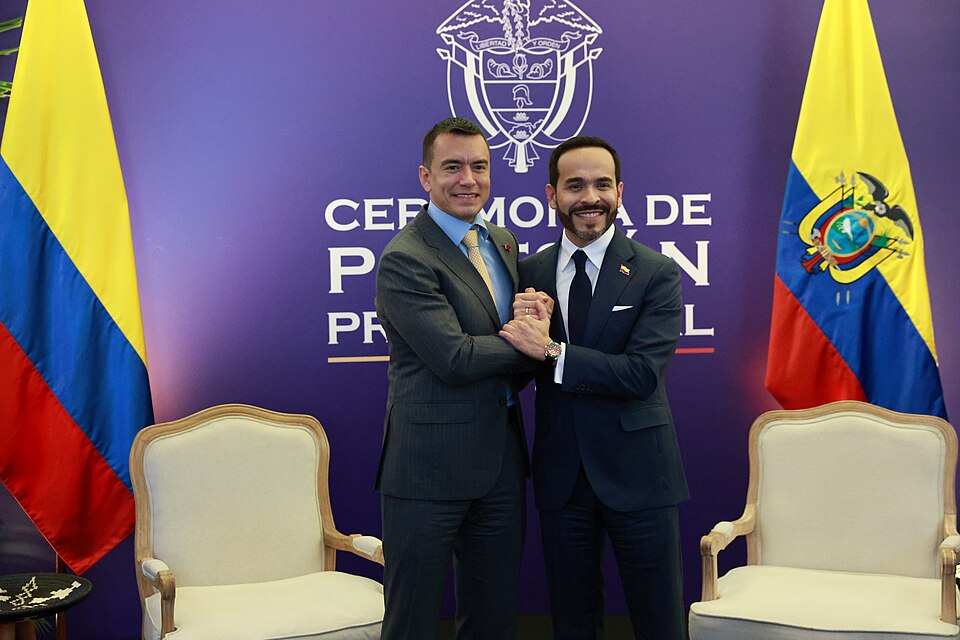
With his movement – “Defenders of the Homeland” – founded less than a year ago, Abelardo de la Espriella intends to put an end to drug trafficking and the illegal armed groups associated with it. The 48-year-old lawyer promises Colombians a better future. Initially ridiculed, the outsider and political novice won the runoff election on June 21 against his left-wing opponent, human rights defender and senator Iván Cepeda.
Donald Trump and US Secretary of State Marco Rubio congratulated him on his election. “Colombia’s best days lie ahead,” and announced that they would work together to curb illegal migration. Argentina’s president Javier Milei his counterpart’s election victory on X with the words: “The lion and the tiger are roaring in Latin America.” He was referring to their self-invented nicknames: Milei is the lion and De la Espriella the tiger. “Freedom is spreading throughout Latin America, and there is no turning back,” he added at the end of his post.
Eduardo Bolsonaro, the son of former Brazilian president Jair Bolsonaro, commented on the post. Bolsonaro lives partly in the United States and has been chosen to build links between the right in Brazil and the United States. He wrote, “Now only Brazil is missing,” beneath a map of South America showing mainly blue-shaded countries. The intended message: the right now governs almost everywhere.
Ultraright political actors in Latin America are increasingly looking to international right-wing populist movements in the United States and Europe and adopting their strategies and rhetoric. This was already clearly evident in the case of Nayib Bukele in El Salvador and Javier Milei in Argentina – and now also in De la Espriella’s electoral victory in Colombia.
From Progressivism to a Populist Alternative
While less than one percentage point separated the progressive candidate Cepeda from the ultraright outsider in Colombia, the results in Ecuador, Argentina and Chile were relatively clear, with margins of between 11 and 16 percentage points. The particularly narrow result in Colombia shows just how undecided – or polarized – the population is. In the El Hilo podcast, Argentinian historian Camila Perochena argues that voters appear deeply unsettled. This is also due to the failure of left-wing promises: rising everyday crime was the decisive campaign issue in Ecuador, El Salvador, Chile and now Colombia, reflecting a desire for a radical change of course.
Over the past four years, Colombia’s first left-wing president, Gustavo Petro, turned his back on this kind of politics and instead focused on social justice, poverty reduction, reforms and dialogue. Yet corruption scandals, escalating armed conflicts, a growing civilian death toll in several regions and the failure of his peace talks appear to have convinced Colombians that the left-wing path no longer offers a solution. They chose the opposite extreme instead.
Colombian society has by no means turned away from politics. At more than 60 percent, voter turnout was higher than it had been in decades.
The division among expatriate voters is striking. While the left-wing candidate prevailed at European consulates, the vote in the United States reflected the wider political climate there: more than 80 percent of Colombian voters opted for De la Espriella. This may be explained by the history and social backgrounds of the respective communities. Most Colombians living in the United States fled the violence of drug trafficking and guerrilla groups during the 1980s and 1990s and are now often entrepreneurs. By contrast, a disproportionate number of academics and young people have emigrated to Europe since the 2000s – whether to study, pursue professional qualifications or seek political asylum from far-right paramilitarism.
Petro appears to have promised too much with his “Change for Life” agenda – without ever acknowledging that four years in government are simply not enough for a country shaped by more than 50 years of armed conflict. These unfulfilled promises have now driven many Colombians into the arms of the other extreme: away from peaceful dialogue and toward a radical change of course.
For many people in Latin America, everyday street crime weighs more heavily than structural poverty. De la Espriella, who once represented high-ranking cartel bosses in the United States, is now promising to build ten “megaprisons” based on regional models. The fact that experience shows such complexes can benefit gangs such as Tren de Aragua and facilitate systematic human rights violations barely features in the debate.
Much like Milei with his chainsaw in Argentina, De la Espriella wants to put the state on a drastic slimming regimen. He promised voters 40 percent reduction to free up funding for his security projects. He intends to abolish nine ministries. Apart from the Ministry of Equality, which had already been dissolved by his predecessor for institutional reasons shortly before he took office, he has not yet specified which ministries he means. The interior and defense ministries are to be “simplified” and “reduced.” “The state cannot be the country’s main employer,” he argues. The state, he says, is the country’s most important enterprise and must be run in a way that prevents money from being wasted. Shortly before his inauguration, however, he announced plans to reorganize the country’s diplomatic presence and close more than 14 embassies. Diplomatic relations with Cuba and Nicaragua are to be severed entirely, while in countries such as Hungary, South Africa and Ghana, embassy closures will be justified as part of the effort to reduce bureaucracy.
This promise of radical measures and hard-line symbolic politics, combined with a charismatic figure, has recently delivered electoral victories not only in Colombia but also for José Antonio Kast in Chile.
Alongside radical austerity plans, De la Espriella relies above all on military symbolism. With gestures such as an army salute, the slogan “Firmes por la Patria” (“Steadfast for the Homeland”) and his call for more permissive gun laws, he deliberately appeals to the armed forces and veterans. “It makes no sense for law-abiding, hard-working citizens to be unarmed while criminals can obtain weapons cheaply,” he declares. In Chile, Kast is reinterpreting the legacy of the Pinochet dictatorship; in Argentina, Milei is breaking with the country’s culture of remembrance surrounding the military junta. Argentina’s score for the BTI reconciliation indicator fell from 7 to 5 points between 2024 and 2026 – a sign that historical atrocities are increasingly being ignored. Similar developments can be expected in Chile under Kast, an admirer of Pinochet, while Colombia improved slightly from 6 to 7 points during the past two years under its first left-wing government.
De la Espriella follows the patterns established by Milei and Kast. He places religion and the traditional family at the heart of his government and embodies classically conservative values by presenting himself as a God-fearing family man and hard-working patriot.
His electoral calculation was obvious: he positioned himself as a strongman and an uncompromising alternative to the left-wing candidate Cepeda, whose agenda stood for human rights, secularization, a reduction in the size of the military and abortion rights. In the end, the promise of order, faith and traditional values prevailed over calls for social modernization.
This strategy has also proved successful in El Salvador for the past seven years: Bukele currently has the support of 85.5 percent of the population. In Ecuador, the policy of the “iron fist” appears to be less effective: only 21 percent currently believe the president is doing a good or very good job. The Country Report on Colombia already showed under the right-wing conservative Iván Duque (2018–2022) that nationwide militarization did not curb violence, but instead led to grave human rights violations by the police and armed forces. The country could now fall back into such conditions – or even more drastic ones.
Right-wing parties offer simple, hard-line solutions that appeal to many voters, and they are strongly centered on a single individual. This is once again evident in Colombia’s election. Particularly revealing is the new president’s self-image. While the media, academics and his political opponents unanimously classify De la Espriella as “ultraright,” “libertarian” or “right-wing populist,” he rejects all ideological labels. He prefers to portray himself as a purely pragmatic “anti-politician” and social outsider who does not think in political categories but merely upholds “morality, law and order.” This rhetoric of the resolute, ideology-free leader resonates particularly strongly with voters disillusioned with politics.
The Rise of the New Right: What Sets It Apart from the Traditional Right?
At its core, the new right emerged as a reactive countermovement to the advances in social inclusion made in the early 21st century. As left-wing governments placed a strong emphasis on minority rights and identity politics, some sections of the population developed a subjective fear of losing their social status and identity. This was reinforced by corruption scandals – such as Lava Jato in Brazil – and rising crime, which caused voters to lose confidence in the established political forces. Because traditional right-wing parties were perceived as too moderate and ineffective, many citizens turned to more radical alternatives.
This wave is not, however, confined to protest sentiment; it is becoming structurally entrenched. As has already happened in other countries in the region, this process can now be observed clearly in Colombia: with De la Espriella, the traditional right-wing elite has gained a loud new rival. His political movement has only been recognized as an official party since the beginning of August. It has consequently gained access to state party funding, can place its own candidates on electoral lists and can establish itself institutionally throughout the country over the long term.
In both its substance and its methods, the new right differs fundamentally from its predecessors, according to historian Camila Perochena and political scientist Alberto Vergara.
Whereas the neoliberal right of the 1990s was primarily focused on free-market policies, the new right is waging a culture war – particularly, though not exclusively, against progressive voices. Abelardo de la Espriella, for example, described the radical left as a cancer that must be “destroyed.” According to Chilean political scientist Cristóbal Kaltwasser, the new right deliberately exploits polarization surrounding traditional values, religion and the military to mobilize voters. In addition to this strongly personalized style of politics, Perochena and Vergara identify the reinterpretation of the past and the narrative of former “golden ages” as playing a key role.
Instead of cultivating a distinct Latin American identity, the new right connects with transnational networks. In alliance with Trump or Spain’s Eurosceptic Vox party, it invokes anti-communism, the defense of “Western civilization” and the concept of the Iberosfera – a transnational, postcolonial space intended to unite the Spanish- and Portuguese-speaking world in an alliance based on a shared language and culture.
Examples such as Brazil and Guatemala demonstrate that the continent is by no means shifting uniformly to the right. As Kaltwasser explains, a society rejects the new right when progressive forces retain voters’ trust and the mass disappointment necessary for such a shift fails to materialize. In Guatemala, reform candidate Bernardo Arévalo won the 2023 presidential election, while Lula da Silva prevailed in Brazil in 2022.
Colombia’s narrowly decided election and declining support for the government in Ecuador are current examples of this dynamic. On social issues such as abortion and equality for same-sex couples, public attitudes are in fact becoming increasingly liberal. As Kaltwasser concludes, the rise of ultraright actors rarely reflects a broad ideological realignment. It is primarily a symptom of deep-seated political fatigue and a desire to cast a protest vote.
De la Espriella was elected mainly because of disappointment over Petro’s unfulfilled promises of peace, and probably also because the left-wing candidate Iván Cepeda appeared somewhat old-fashioned next to him. Cepeda, for example, only discovered social media as a campaign platform shortly before the end of the race.
The victory by no means guarantees that the new right will endure. Colombia’s left-wing opposition is stronger than ever. Cepeda will continue his decades-long struggle for social justice and peace through dialogue. The human rights defender also learned a great deal during this campaign. The pendulum could therefore swing back to the left in 2030 – particularly if Abelardo fails to bring the security situation under control.