
The Erosion of Democracy – The Explosion of Violence
In 2025, the number of armed conflicts reached a historic high. At the same time, democracy is under pressure worldwide. Is there, then, a connection between the erosion of democracy and the explosion of political violence?
The evidence is clear: In 2025, the world saw 65 armed conflicts involving states, the highest number since the Second World War. Since 2010, the number of these conflicts has nearly doubled, while the death toll from all armed conflicts has increased fivefold to 245,000, according to the latest figures from the representative Uppsala Conflict Data Program (UCDP) at Sweden’s Uppsala University. UCDP collects data on various categories of armed conflict above a threshold of 25 deaths per year.
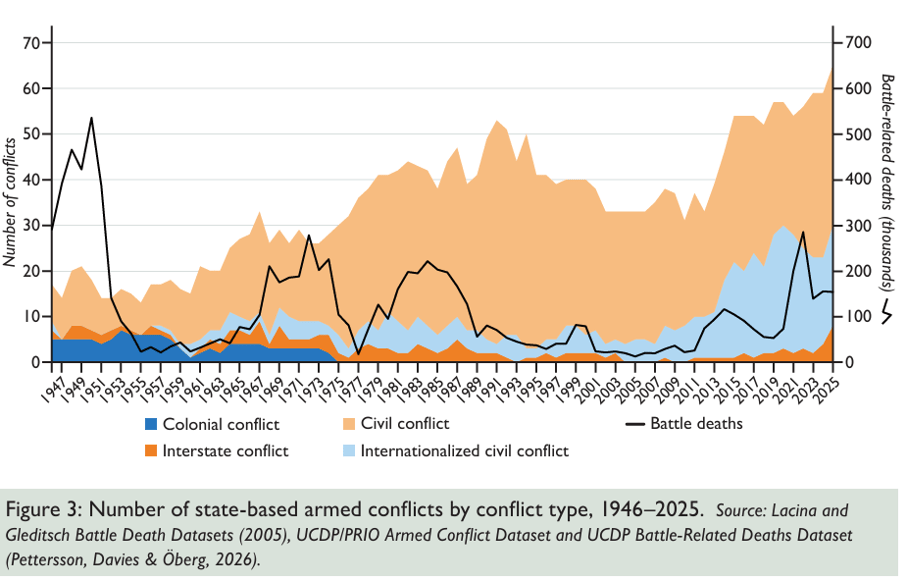
Number of armed conflicts involving states, 1946–2025. Siri Aas Rustad, Conflict Trends: A Global Overview, 1946–2025, PRIO PAPER 2026, p. 12
The prominent non-governmental organization ACLED (Armed Conflict Location & Event Data) confirms this finding, recording more than 200,000 “violent conflict events” with — according to conservative estimates — more than 240,000 fatalities. Unlike UCDP, ACLED records “violent conflict events” regardless of the number of casualties. In 2025, an estimated 831 million people, 16% of the world’s population, were exposed to armed conflict. These are people who — depending on the severity of the event — live within a radius of 1.2 or 5 kilometers of events such as battles, explosions, remote violence, or violence against civilians.
Military Spending Is Surging
Yet armed conflicts are not the only thing to have increased significantly. Military expenditure also reached levels in 2025 unseen since the end of the Cold War in the early 1990s, both in Europe and globally. According to the Stockholm International Peace Research Institute (SIPRI), global military expenditure reached a record high of USD 2.887 trillion in 2025 — an overall increase of 41% and the eleventh consecutive annual rise. Europe’s share of military expenditure grew most strongly in 2025, driven by Russia’s war against Ukraine, rising by 14% to USD 864 billion — the largest increase since the end of the Cold War.
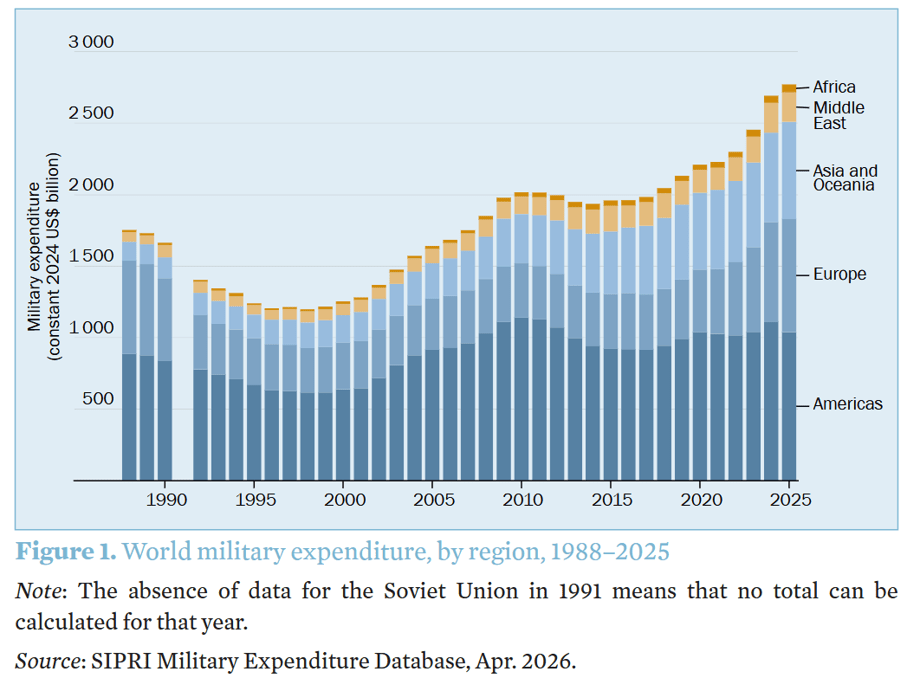
World Military Expenditure by Region, 1988-2025. SIPRI Military Expenditure Database, Apr. 2026.
The Erosion of Democracy…
Another finding is equally clear: The results of the Bertelsmann Transformation Index (BTI) 2026 document a global erosion of democratic standards, the rule of law, and market-economy standards that has continued for 20 years. As a result, the global balance between democracies and autocracies has reversed: While 55% of all countries examined by the BTI in 2006 were democracies, today 56% are governed autocratically (77 countries). Of these autocracies, 52 — two-thirds — are highly repressive dictatorships or failing states in which fundamental rights are systematically violated. At 38% of all countries examined, the share of these hard-line autocracies has reached its highest level since the BTI was established in 2006. At the same time, the rule of law has been continuously and profoundly eroded. Two-thirds of the countries surveyed since 2006 are less democratic today than they were 20 years ago.
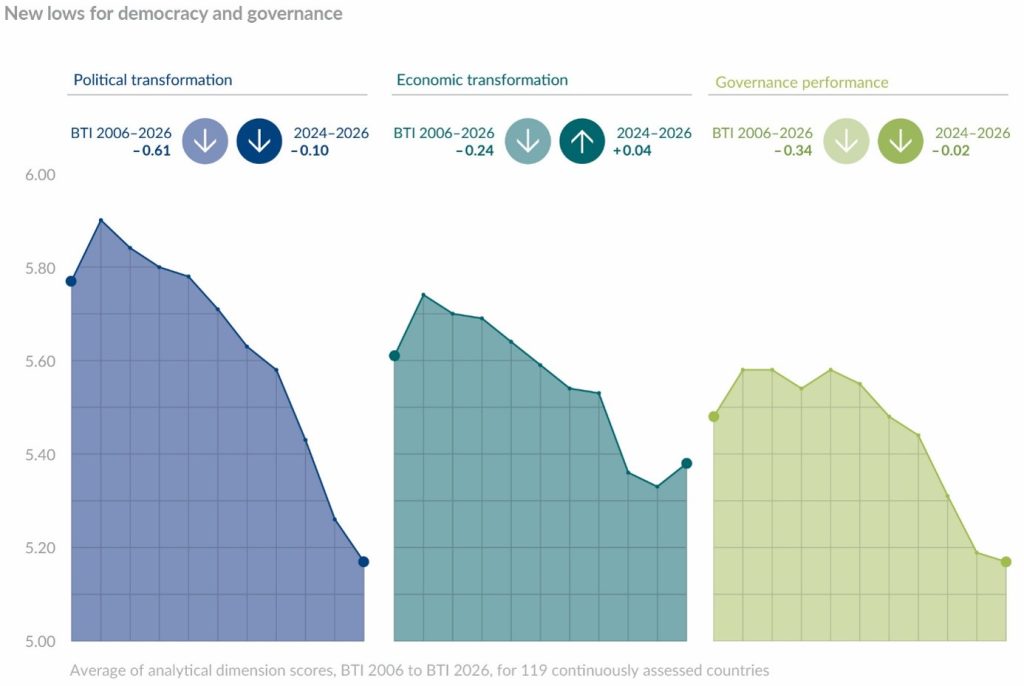
Bertelsmann Transformation Index 2026
…and a Less Peaceful World
This doubly negative finding is also reflected in the Global Peace Index (GPI) of the Sydney-based Institute for Economics and Peace (IEP), which was launched in 2007 and now assesses the peacefulness of 162 countries in its annual index. The GPI measures a country’s level of peacefulness using 23 indicators across three domains: ongoing domestic and international conflict, societal safety and security, and the degree of militarization. In 2025, it concluded: “Global peace is at its lowest level since the inception of the Index, while the conditions that precede conflict are the worst since WWII. Global peacefulness has deteriorated every year since 2014, with 100 countries deteriorating over the last decade.”
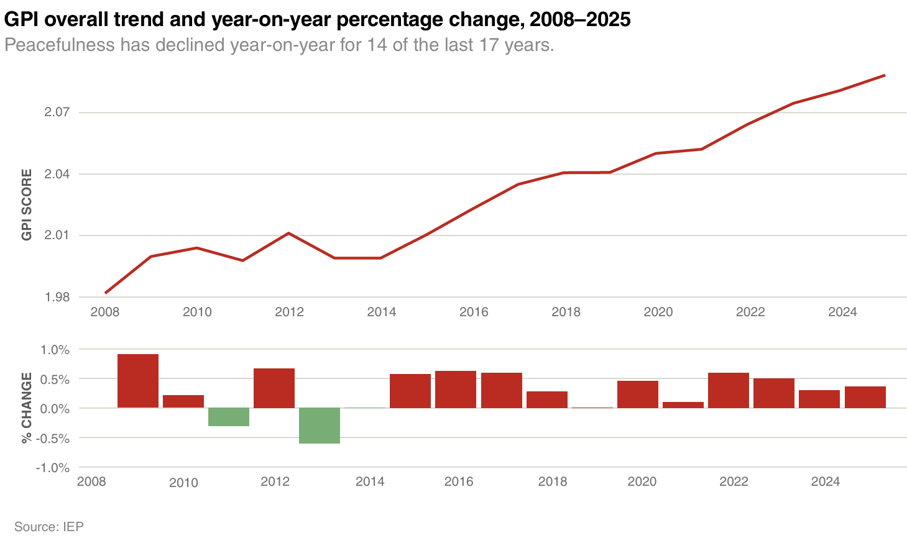
GPI Peacefulness-Trend. Global Peace Index
Democratic Peace
There are therefore evident connections between the global decline of democracy and the increase in armed conflicts around the world. The Global Peace Index reinforces this conclusion: Since 2008, the GPI has identified Western and Central Europe as the world’s most peaceful region, with Iceland consistently leading the ranking, followed in 2025 by Ireland, Austria, Switzerland, Portugal, Denmark, Slovenia and Finland, as well as New Zealand — all of them smaller, stable democracies. This finding is reflected in the theory of democratic peace, according to which democracies do not wage wars against one another and are generally less inclined to use violence. This is attributed to a normative disposition to resolve domestic — and, consequently, foreign-policy — conflicts through dialogue and compromise; to the institutional checks and balances found in democracies; and to the utilitarian cost-benefit calculations of citizens whose views shape political decision-making and for whom wars are costly, risky and therefore generally unpopular.
The Limits of Democratic Peace
However, despite impressive empirical evidence, the theory of democratic peace is not uncontested. For one thing, some cases have shown that while democracies may adhere to the principle of peace in their relations with one another, they can be quite prone to aggression and violence toward autocracies. The US war against Iraq in 2003 is a classic example. In its research on the antinomies of democratic peace, the Peace Research Institute Frankfurt (PRIF) has characterized this as its “dark side”. This is primarily a problem of international order, its anarchic character, and the absence of a monopoly on the use of force.
The second qualification concerns the finding that processes of democratization have repeatedly been accompanied by violent confrontation in the past, extending as far as civil war. Research by the Peace Research Institute Oslo (PRIO) has located the risk of such outbreaks of violence precisely midway between stable democracies and stable autocracies. The argument is that democratization processes lead to a form of hybrid system characterized by weak institutions and strong mobilization, and thus to a “political incoherence” that invites violence. In the past, this has posed problems for democracy promotion.
At present, however, as shown above, we are dealing less with democratization than with autocratization, which likewise mobilizes resistance and thus contributes to political destabilization — up to and including state failure. Such failed states lack an accepted monopoly on the use of force. As in most previous years, the BTI 2026 identified the Democratic Republic of the Congo, Haiti, Libya, Myanmar, Somalia, Sudan and South Sudan, as well as Syria and Yemen, as failed states. It is therefore no coincidence that, for the past 20 years, internal violence in its various manifestations — from open civil war to recurrent “communal violence” — has been concentrated in these countries. As “forever wars,” these conflicts form a kind of stable baseline in which entrepreneurs of violence continuously reproduce themselves.
One example is the operations of the paramilitary Rapid Support Forces from Sudan’s Darfur region, which were responsible for more than 4,000 civilian deaths in 2025, accounting for 11% of all globally recorded victims of such irregular forces. Another example, alongside Latin American drug cartels, are the criminal gangs of Viv Ansanm, which claim control over growing parts of Haiti. In addition, Islamist groups continue their activities in various forms, from Islamic State and al-Qaeda to Tehreek-i-Taliban Pakistan, advancing from the Middle East through the Sahel into ever new regions.
Although these are predominantly protracted violent conflicts of varying intensity, according to UCDP and ACLED they, too, have increased significantly in recent years. At the same time, intervention by external powers in such conflicts has also increased, and with it their internationalization.
Autocratic War
After the end of the Cold War, classic interstate wars were in retreat and appeared to be a throwback to a bygone era. In recent years, however, this trend has reversed. According to PRIO, both interstate wars and civil wars involving states have risen to more than 50 in recent years, reaching a peak of 65 in 2024: “The only other period since 1946 with a comparable level of conflict was the early 1990s.” Both developments have occurred in parallel with the spread of autocratic regimes. Indeed, it is predominantly autocracies that are involved in the six interstate wars fought in 2025:
- Pakistan and Afghanistan, which are engaged in a simmering border conflict that repeatedly escalates into large-scale military confrontation;
- Pakistan and India, which fought a brief but rapidly escalating war in May 2025 following attacks in Kashmir;
- Rwanda and the Democratic Republic of the Congo, which have been engaged in an ongoing war since 2022 despite several ceasefire agreements;
- Thailand and Cambodia, between which a border war erupted in July 2025 and has since continued as a low-intensity war;
- Russia’s war against Ukraine, which was waged covertly between 2014 and 2022 and openly ever since;
- and, finally, the war waged by Israel and the United States against Iran in June 2025 and again since February 2026.
UCDP adds to this list the wars waged by Israel, the United States and the United Kingdom against Yemen, as well as Israel’s invasion of Syria (but not Lebanon), resulting in the highest number of interstate wars since 1945.
Unlike Iran, the United States and Israel are not autocracies. Under Trump and Netanyahu, however, their checks and balances — and thus a central condition of democratic peace — have been compromised to such an extent that there is currently no longer effective oversight of the executive.
These wars demonstrate that, as autocracies spread, the liberal world order and its prohibition on the use of force are increasingly disregarded. Displays of power, violations of international humanitarian law and naked imperialism are their hallmarks — both at home and abroad.
The dramatic nature of this development is evident in the fact that such interstate wars account for the greatest material destruction and the largest numbers of casualties. According to PRIO, the past four years, with around 740,000 casualties, therefore constitute the most violent period since the Cold War. Europe stands out in particular because of Russia’s war against Ukraine. On the Ukrainian side, between 2022 and 2026, the war claimed between 55,000 military lives (according to official Ukrainian figures, in addition to at least 16,000 civilian deaths) and 140,000 (according to the Washington-based Center for Strategic and International Studies). On the Russian side, in addition to 1,000 civilian deaths, up to 352,000 soldiers have been killed, according to the news agency Meduza. It is a war of attrition in which an autocracy, regardless of the losses, is fighting against the self-determination of a democracy.
Russia is thus an almost textbook example of imperialism rooted in autocracy. But Russia also demonstrates how war reinforces the autocratic character of a regime. This evokes memories of a similar war: It was Joseph Stalin’s death in March 1953 that finally enabled the negotiations, which had until then been unsuccessful, to achieve a breakthrough in July 1953.
